
Kreuzberg, Via Emilia
Wreckage and Liturgy
by Silvia Ravenda – 10 june 2026
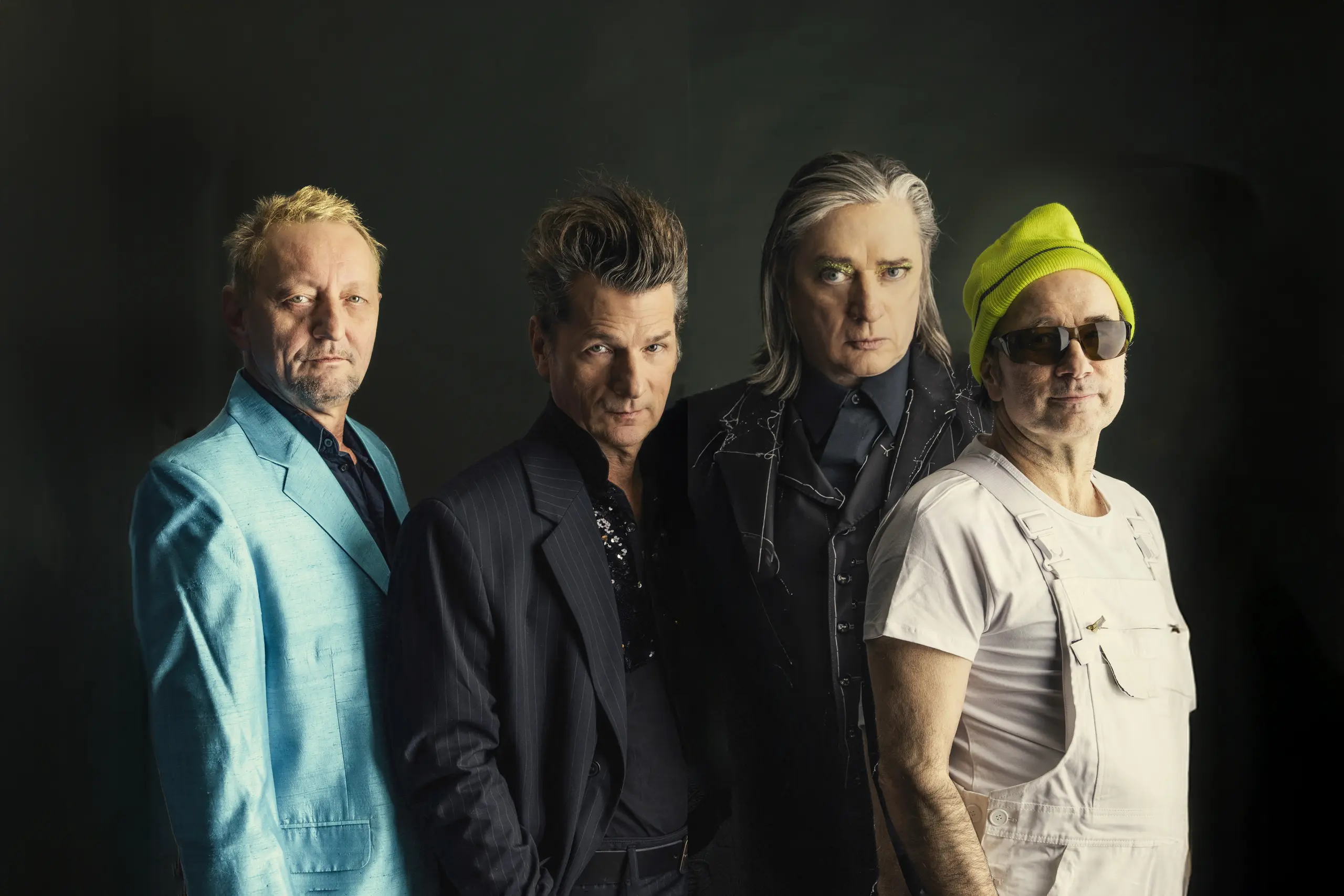
On 12 September 2026, Einstürzende Neubauten will enter the Teatro Municipale Valli in Reggio Emilia. Put like that, it sounds like a date in a programme. In reality, it is a collision.
Because the Valli, in this story, has already been occupied by the right ghosts. In October 2023, Giovanni Lindo Ferretti and Annarella Giudici entered the stalls like a bridal couple, over Massimo Zamboni’s arpeggios and Danilo Fatur handling his tools. CCCP’s Gran Gala Punkettone had forced the city to face again a truth that time had tried to domesticate: that group, born between Reggio Emilia and West Berlin, had been one of Italian rock’s most peacefully violent and least predictable forms.
Three years later the Neubauten arrive, and they arrive with metal and with Blixa Bargeld’s voice. They arrive in the city where their method was translated into another language through a drum machine, the red province, nervous guitar, silent soubrette and tractors. Berlin had invented wreckage as sound. Reggio Emilia turned it into liturgy.
The concert at the Valli matters because it places origin and deformation in the same room. Sheet metal and a tractor hood. Kreuzberg and Via Emilia.
At the beginning there is West Berlin, in the early Eighties. At the Risiko Bar on Yorckstraße, on the border between Kreuzberg and Schöneberg, beneath the path of the S-Bahn, Blixa Bargeld worked as a bartender. At Dschungel he was remembered as androgynous, lanky, with asymmetrical make-up, ballet tights, black latex and rubber boots. No musical training and, above all, no orderly notion of a career.
On 1 April 1980, he steps onto the stage at the Moon Club with N.U. Unruh, Beate Bartel and Gudrun Gut. Shortly afterwards, Unruh sells the drum kit to pay the rent. From that loss comes the decisive turn: tools and scrap metal, objects bought, far more often found. Iron against iron. A percussion rig assembled according to the logic of necessity. Bargeld has often described it with the coldness of someone who distrusts mythology: first came the material condition, then the aesthetic.
Neubauten are born out of lack, inside a city where everything seems salvaged and unstable. Kreuzberg was one of West Berlin’s poorest districts, enclosed by the Wall on three sides, full of empty houses and occupied spaces. SO36, on Oranienstraße, was the gathering point: a former cinema, then a Penny supermarket, reopened as a concert venue in 1978 by Achim Schächtele, Klaus-Dieter Brennecke and Andreas Rohé, before Martin Kippenberger’s tenure. Dead Kennedys, Die Haut and Nick Cave’s Birthday Party, newly arrived from Australia, passed through there. Iggy Pop and Bowie had lived not far away, in Schöneberg, and their Berlin had already become nocturnal mythology.
Kollaps, in 1981, commits this to record. ZickZack releases an LP that seems to come from a room without windows: scraped sheet metal, industrial percussion, a screamed voice and poor materials used with almost brutal precision. With F.M. Einheit, Neubauten set down on Kollaps the first core of their vocabulary. Hacke, who joined very young during that phase, would soon become a decisive part of the live and compositional machine. At the ICA in London, on 3 January 1984, Concerto for Voice and Machinery lasts just over twenty minutes. Drills. Pneumatic hammers. A perforated stage. Smoke in the hall. The performance stopped. For once, the legend has the virtue of concreteness: that music really wanted to alter physical space.
Meanwhile, in the summer of 1981, in Charlottenburg, inside a disco called Superfly, something less noisy yet equally decisive happens. Massimo Zamboni is twenty-four, has dropped out of medical school in Modena, plays guitar and works in a pizzeria. Giovanni Lindo Ferretti is twenty-seven, comes from Cerreto Alpi, has worked as a psychiatric care worker and has been active in Lotta Continua. Two Reggio natives far from home, on the dance floor of a Berlin club. They recognise each other before they truly know each other.
Zamboni would say they had gone to Berlin to escape the idea of working. In another, brighter formulation, he would speak of two lads from Reggio Emilia in search of light. Ferretti would use a more restless image: CCCP were born from that strange symbiotic being.
They return to Italy and found MitropaNK. The following summer they set off again with Umberto Negri. That is where the name arrives: CCCP – Fedeli alla linea. A Soviet abbreviation adopted by boys from Emilia in West Berlin. That alone would be enough to explain the short circuit. In the underground clubs, between K.O.B. and Spectrum, they hear music built with unsuitable means: struck metal, physical low frequencies and, above all, the voice used as material. That lesson reaches Emilia without passing through imitation.
Ferretti and Zamboni bring back from Berlin a licence: to use what is there, even the ugly, even the poor. Neubauten work on the wounded city through wreckage, construction sites and sheet metal. CCCP work on the province through a drum machine, angular guitar, anchoring bass, pro-Soviet icons and dance-hall theatre stripped to the bone. Residual Catholicism and the Apennines.
In Berlin their music is danced to. In Italy, at the first documented concert, on 3 June 1983, in the gym of the Circolo ARCI Galileo in Reggio Emilia, the audience stands still. Paralysed. That bare line-up cannot yet bear the full scenic impact. It needs a presence that Italian rock at the time cannot even name.
Enter Annarella Giudici. Benemerita Soubrette. Frontal and impassive. With her, the concert stops being mere execution and becomes a tableau vivant, like a secular rite. Then comes Danilo Fatur, former bartender at the Tuwat in Carpi, recruited after a show titled Ose Macho Lopez Frasquelo in Wojtyla sadomaso show. Fatur carries the mechanical part of Emilia on his body. One evening he arrives with a tractor hood. Half man, half agricultural machine. Berlin sheet metal has found its Po Valley equivalent.
Here the parallel with Neubauten takes shape. Bargeld and his companions drill through the stage with pneumatic hammers. Fatur climbs onto a nail-studded stylite’s pillar. Annarella climbs up with him. Ferretti declaims like a mystical functionary before the end of the Soviet empire, before that empire has even truly fallen. Berlin noise was urban, sharp, from a walled city. In CCCP it becomes provincial political theatre. A cold, erotic, Catholic and communist province in the same breath.
Kollaps and Affinità-divergenze fra il compagno Togliatti e noi speak from two extremes of the same wound. Kollaps, 1981, uses the city as a metal body. Affinità-divergenze, 1986, uses Emilia as ideological neurosis. CCCP’s first LP comes out on red vinyl for Attack Punk, with a real-socialist cover. It closes with Emilia Paranoica, with Ferretti reciting a sunlit land transformed into a psychic wasteland. “I’m waiting for an emotion more and more indefinable.” In there, Via Emilia becomes a mental and political corridor. Punk, in Italy, stops being only speed and becomes a posture of the body before history.
From that moment, the two worlds diverge. Neubauten refine their machine. Halber Mensch, in 1985, records a new discipline at Hansa Studios. Yü-Gung, in the Adrian Sherwood version, opens that metal to a more physical circulation, almost club-industrial. Silence Is Sexy, in 2000, brings the void inside the composition. In 2002, when the word crowdfunding had not yet entered the lexicon, they build the Supporter Project with Erin Zhu: fans linked remotely to the Bunker sessions, hours of rehearsals streamed live, music watched as it comes into being. In 2024 they release Rampen – apm: alien pop music, a double album drawn from the improvisations of the 2022 tour and reworked at Candy Bomber in Berlin. The Rampen are launch ramps: minimal conditions, then the leap. Bargeld feeds the electronic prompter with fragments of text and unfinished materials. Fifteen tracks, with Planet Umbra born directly in the studio.
Then April 2025: Alexander Hacke leaves the band. More than forty years inside, out in a single line. In March 2026 Josefine Lukschy joins, a Berlin musician already active in Crashpad. At the Valli, Neubauten will arrive with a recent wound in the line-up. Historic body and new nerve.
CCCP, meanwhile, have returned through the front door of their city. In 2023, the exhibition Felicitazioni! at the Chiostri di San Pietro occupies 1,800 square metres and twenty-eight exhibition spaces. Then the Gran Gala Punkettone at the Valli. Then the live return in 2024. Then Ultima Chiamata in 2025. The risk was obvious: to become a holy card for veterans. Something more ambiguous happened. Reggio Emilia looked at CCCP as one looks at something of its own that has meanwhile become estranged. It recognised them without fully managing to tame them.

That is why the Neubauten date at the Valli carries weight. That stage has already seen the other half of the argument return. It has seen Annarella and Ferretti enter like a bridal couple, Fatur move his objects. Now it receives Bargeld, whose voice seems to incise the sentence as he pronounces it. Instruments made of discarded material and percussion that still carry within them the idea of iron as necessity. A band that began by making sound out of what the world left at the margins.
The Reggio Emilia of 2026 is far from the Emilia Paranoica of 1986. Yet something remains open. Here, Berlin wreckage has already changed species. It has become tractor and soubrette. It has become a Soviet bulletin recited in the voice of a secular sermon. It has become one of the most anomalous forms of Italian punk.
Nostalgia, for an evening like this, is too small a word. At the Valli, the past arrives with sharp edges, without asking to be commemorated. On 12 September 2026, West Berlin enters Via Emilia. The circle closes badly. Fortunately: circles that close too well belong to monuments. Instead, this story still wears rust, theatre and live iron.