
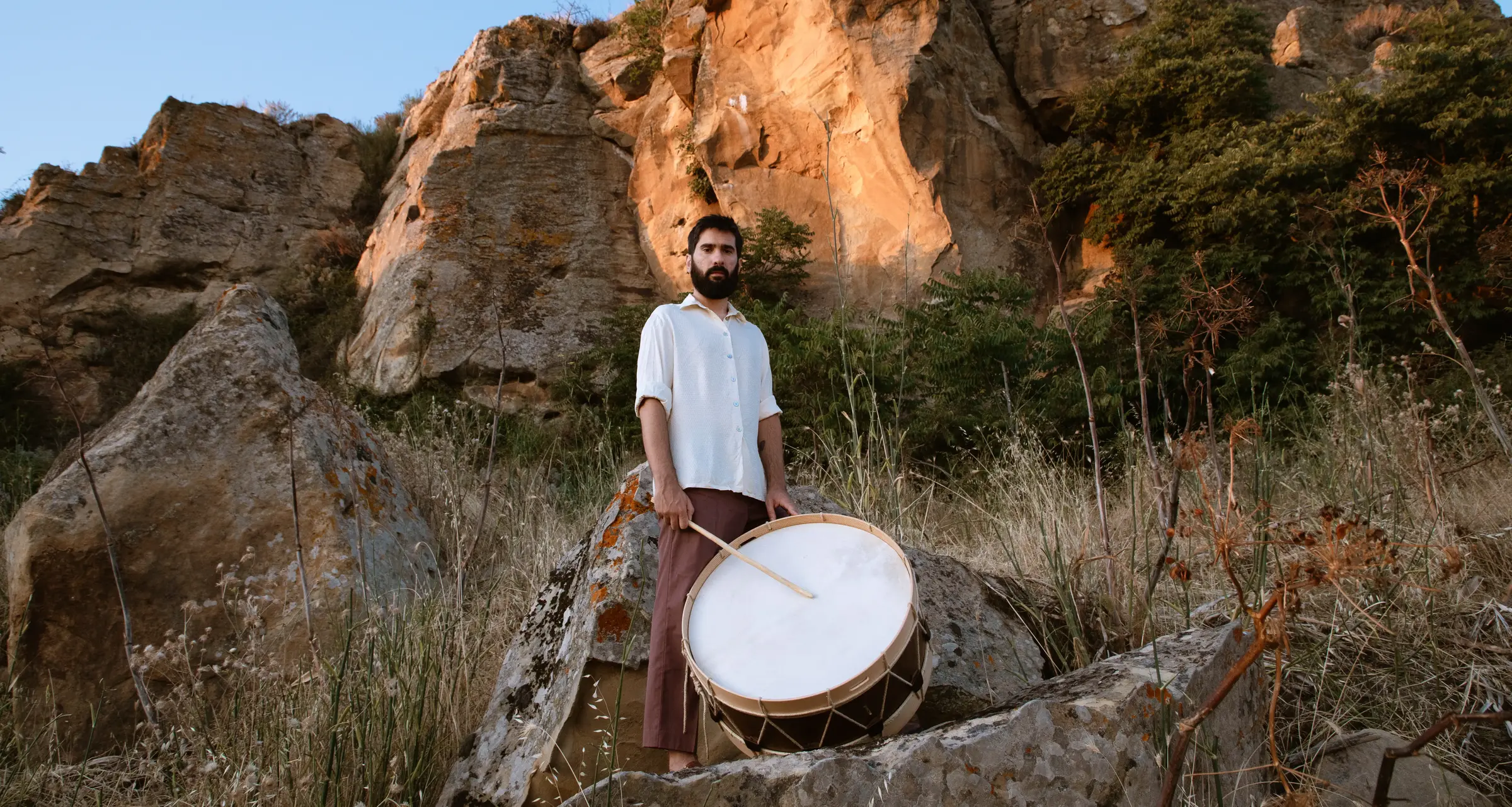
Davide Ambrogio
The Hub - Parma
Friday, 11 December
11.50 PM
In 1954, Alan Lomax and Diego Carpitella recorded a lullaby in Cardeto, in the Aspromonte mountains. Thirty-six years later, Davide Ambrogio was born in nearby Cataforìo, a village in the municipality of Reggio Calabria. That lullaby, “Veniti Sonnu”, is the only track on his debut album whose music he did not compose.
In 2011 he moved to Rome, where he pursued academic and musical studies and joined EtnoMuSa, Sapienza University’s folk music orchestra. He has said that he tried more than eighty instruments, almost always with mediocre results, before narrowing the field to the zampogna, guitar and lira calabrese, and that only singing could remove the filter between his hands and what he wanted to say. He calls the stage rig he built with sound designer Walter Laureti la bancarella, “the market stall”: guitar, lira, zumpettana, drum, loop station and electronics.
Evocazioni e Invocazioni was released by Catalea in 2021. Across its nine tracks, the dialects of southern Aspromonte and the Cosenza area work as timbral material before they function as language; each track serves a ritual purpose: lullaby, protest song, lament, incantation. Ambrogio sings, recites and plays acoustic and electric guitar, a guitar struck with pencils, lira, zampogna, davul, tamburello, nagara, harmonium and synth. “A San Michele”, written with Gianvincenzo Pugliese, had won the eleventh edition of Musica contro le Mafie in 2020. Ambrogio also won Ethnos Gener/Azioni that year; in 2021, Linguamadre, the project he shares with Duo Bottasso and Elsa Martin, received the Premio Loano Giovani. Songlines named the album a Top of the World Album in November 2021.
His second album came out four years later, in November 2025, on the French label ViaVox. Mater Nullius grew out of Ambrogio’s description of the earth as “desacralised”: profaned by its own children, reduced to an object. The album was recorded at two locations in Alia, in the province of Palermo: the Cortese family’s Il Bosco and the Gurfa Caves, whose resonance became part of the recordings. Fourteen tracks, matching the fourteen Stations of the Cross. Its sonic vocabulary comes from southern Italian Holy Week rituals: the drum, troccole and chains. Two craftsmen, Bruno Marzano and Massimo Olla, built a Calabrian Holy Week drum and a steel bass with springs for the album. Laureti and Ambrogio jointly oversaw the artistic production; Laureti also mixed the album and has writing credits on most tracks. The lyrics were written with Anna Ida Cortese after Ambrogio’s collaboration with Pugliese ended. Three tracks retain lyrics by Pugliese.
In May 2026, Mater Nullius won the Premio Nazionale Città di Loano per la Musica Tradizionale Italiana for Best Album of 2025 and also received the Premio Giovani. Artistic directors Jacopo Tomatis and Ciro De Rosa described Ambrogio as “a craftsman of sound”. Since 2021 he has run Voci in Ascolto, a project devoted to oral-tradition singing; he now leads workshops with Giulia Prete in Rome, Palermo, Padua and San Vito dei Normanni. He is unequivocal about the risk facing this repertoire today: once made more palatable, it becomes “yet another consumer product”.