
Metal Beneath the Gilt
by Silvia Ravenda – 14 september 2026
Einstürzende Neubauten perform at Teatro Municipale Valli in Reggio Emilia on 12 September 2026. With Barezzi Way, Barezzi Festival opens the programme for its twentieth edition with a film screening and a concert, showing how a vocabulary born of scarcity became a language.
On 12 September, as part of Barezzi Way and in partnership with Festival Aperto and Fondazione I Teatri, the festival brought Einstürzende Neubauten to Teatro Municipale Valli in Reggio Emilia for a day arranged in two parts. At 6 p.m., B-Movie: Lust & Sound in West-Berlin 1979–1989 was screened in the Sala degli Specchi. At 9 p.m., the concert began in the theatre. The performance was sold out, and a queue stretched beneath the arcades until the doors opened.
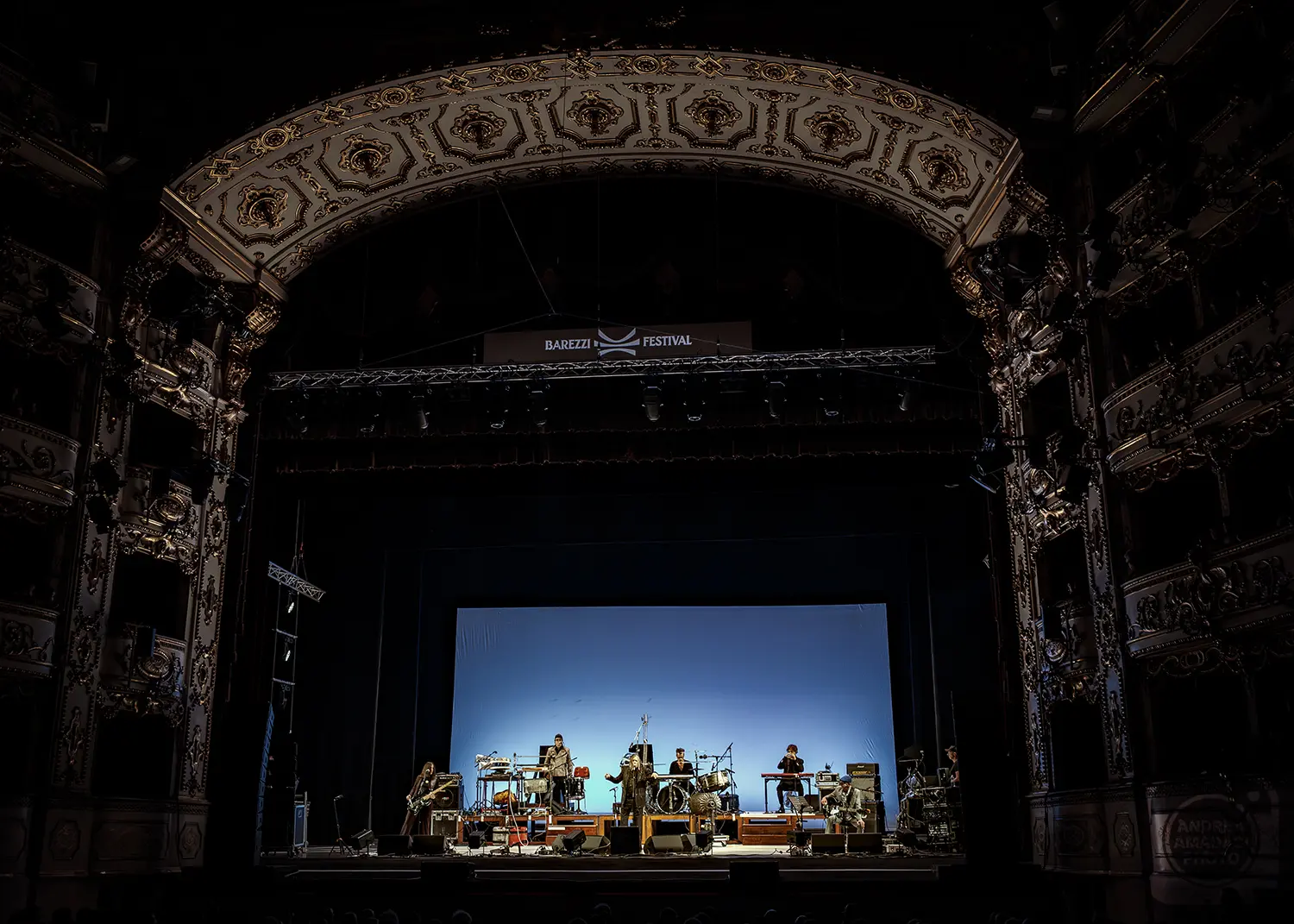
Before the house lights go down, a wooden stage riser stands on the stage at the Municipale, laden with sheets of metal and cylinders. A microphone is trained on a coil spring mounted on a stand. A metal bar cuts across the front of the riser. A large-diameter flexible tube protrudes from a Marshall amplifier head. A stack of steel rings stands nearby. Amid it all is a conventional drum kit. Above it, four tiers of gilded boxes rise towards a vaulted ceiling painted by Domenico Pellizzi in 1856 with allegories of Melodrama, Comedy, Choreography and Tragedy. The theatre seats around 1,100.
The day is built around this coexistence, and the juxtaposition raises the evening’s most compelling question. How has a vocabulary born of limited means, built from sheets of metal, springs and objects picked up in the street, endured for forty-six years and reached the stage of an opera house? Listening to Time, the curatorial theme for Barezzi’s twentieth anniversary, asks what in music has never stopped happening. Programming the film and the concert in the same building on the same evening provides the answer.
One thing about the film matters above all because it alters the way we hear the concert three hours later: the West Berlin it reveals is a sealed room. Its narrator is Mark Reeder, an Englishman from Manchester who arrived in the city in 1978 to buy krautrock records that were impossible to find back home, and the film is assembled largely from archive footage. The result is a private diary superimposed on the political and economic conditions of a wounded city, severed from its own territory and left as a Western island inside East Germany. Rents were low, federal subsidies sustained this showcase of the West, and the population also included young West Germans determined to avoid conscription. East Berlin remains almost entirely off-screen. That missing half is the source of the claustrophobia the film conveys so effectively.
Within that room, the film captures a social code that resurfaces at the Valli forty years later: there was a time, Reeder says, when the music you listened to, the clothes you wore and the clubs you frequented declared who you were. From there it moves through the Berlin of Christiane F., its heroin and children at Bahnhof Zoo presented without gloss, then through new wave and Joy Division, before the circle closes in Manchester. Nick Cave appears in the film for only a few minutes, in archive footage. His appearance provides an exact chronological marker: when he arrived in West Berlin with the Birthday Party in 1982, Einstürzende Neubauten had been active for two years, since their concert at the Moon Club on 1 April 1980. Cave therefore entered a city where the band had already begun to put the grammar of music under strain, turning salvaged materials into instruments.
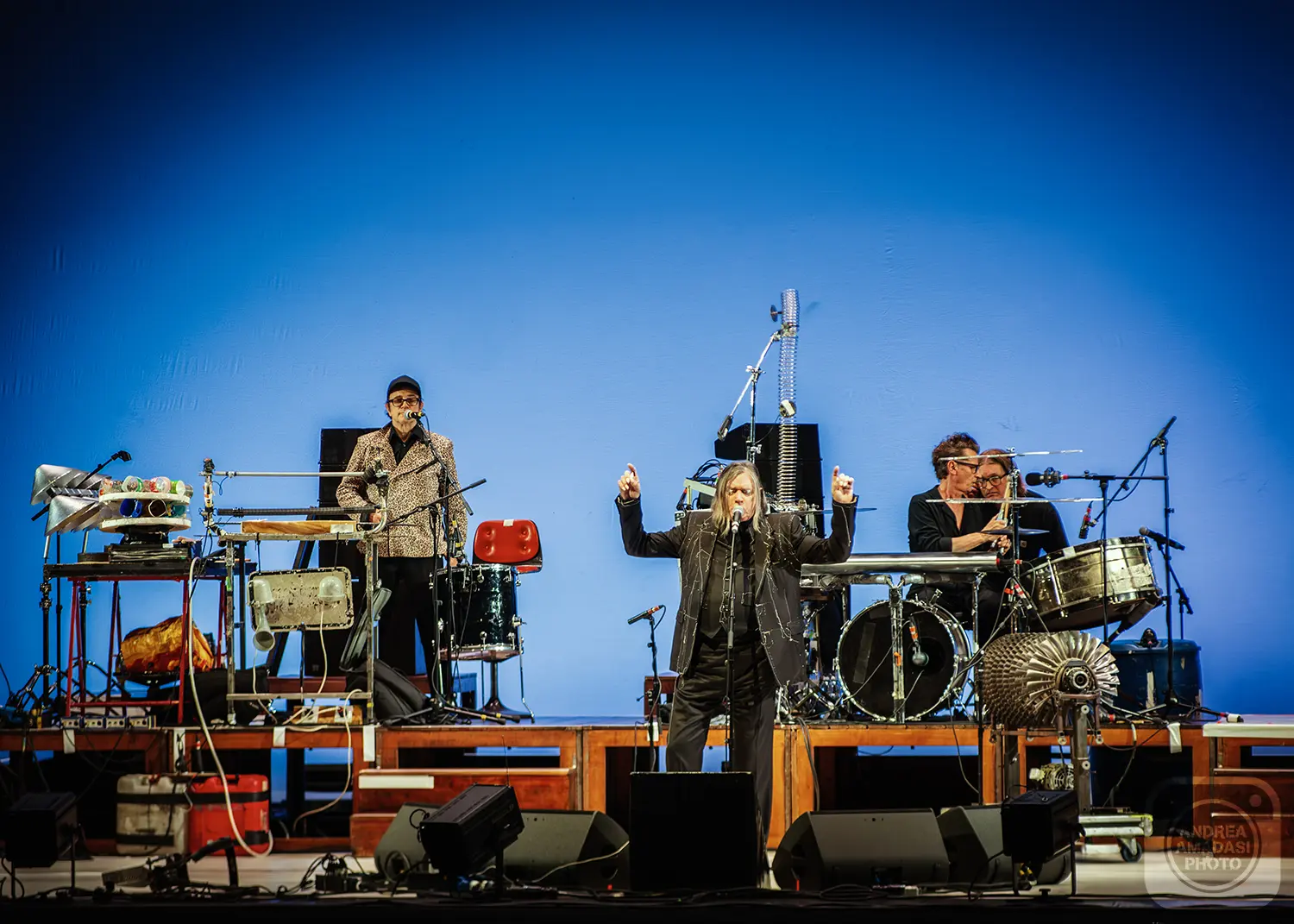
At 9.09 p.m., we head down into the stalls, and the concert begins with “Ten Grand Goldie” from 2020’s Alles in Allem, a recurring opener on the 2026 tour. The line-up on stage comprises Blixa Bargeld on vocals, Josefine Lukschy on bass, N.U. Unruh on drums and percussion, Rudolf Moser on self-built instruments and percussion, Jochen Arbeit on electric guitar, and Felix Gebhard on keyboards. The division of labour between the two metal percussion stations is clear from the stage layout. Unruh sits behind a conventional kit and maintains the pulse. Moser works the material on the riser that carries the self-built instruments. No one moves more than necessary. A single word is spoken: “Buonasera.” During “Pestalozzi”, from Rampen (apm: alien pop music), released in April 2024, Bargeld remains impassive and declaims over the metal percussion. In a room of numbered seats and boxes, the audience has only one channel available to it: applause. It erupts at the close of each number and is still rolling when the next one begins, through all seventeen songs.
The opening stretch runs without pause: “Ist Ist”, again from Rampen, followed by “Wedding” and “Möbliertes Lied” from Alles in Allem. The repertoire is entirely recent, performed by a band that can summon the same weight without putting its violence on display. The sound is built from the pulse. The drums sit forward in the mix, and a metal barrel cuts in at intervals. The industrial percussion locks into the bass, and the voice rests on that core. Arbeit’s guitar hangs back and supports the percussion. Gebhard moves between a Hammond tone and sampled organ sounds, using the keyboards as a harmonic bridge that maintains continuity beneath the metallic attacks. By now, the word “industrial” names only part of what can be heard at the Valli.
The new element is Josefine Lukschy’s bass, set in the rhythmic core between the drums and the metal percussion. The bass reshapes the balance of the parts and remains decisive throughout the set.
On “Grazer Damm”, sung in English, a shopping trolley is wheeled onstage and played. In 1980, the band built instruments from found objects partly because money was scarce, and the trolley belongs to that vocabulary. Today it arrives onstage as a codified instrument, prepared and miked. At the Valli, it carries its part through the entire song. A gesture once liable to seize up now lands on the beat. Precision provides stability and reduces the danger. Later in the set, the Rampe brings that danger back.
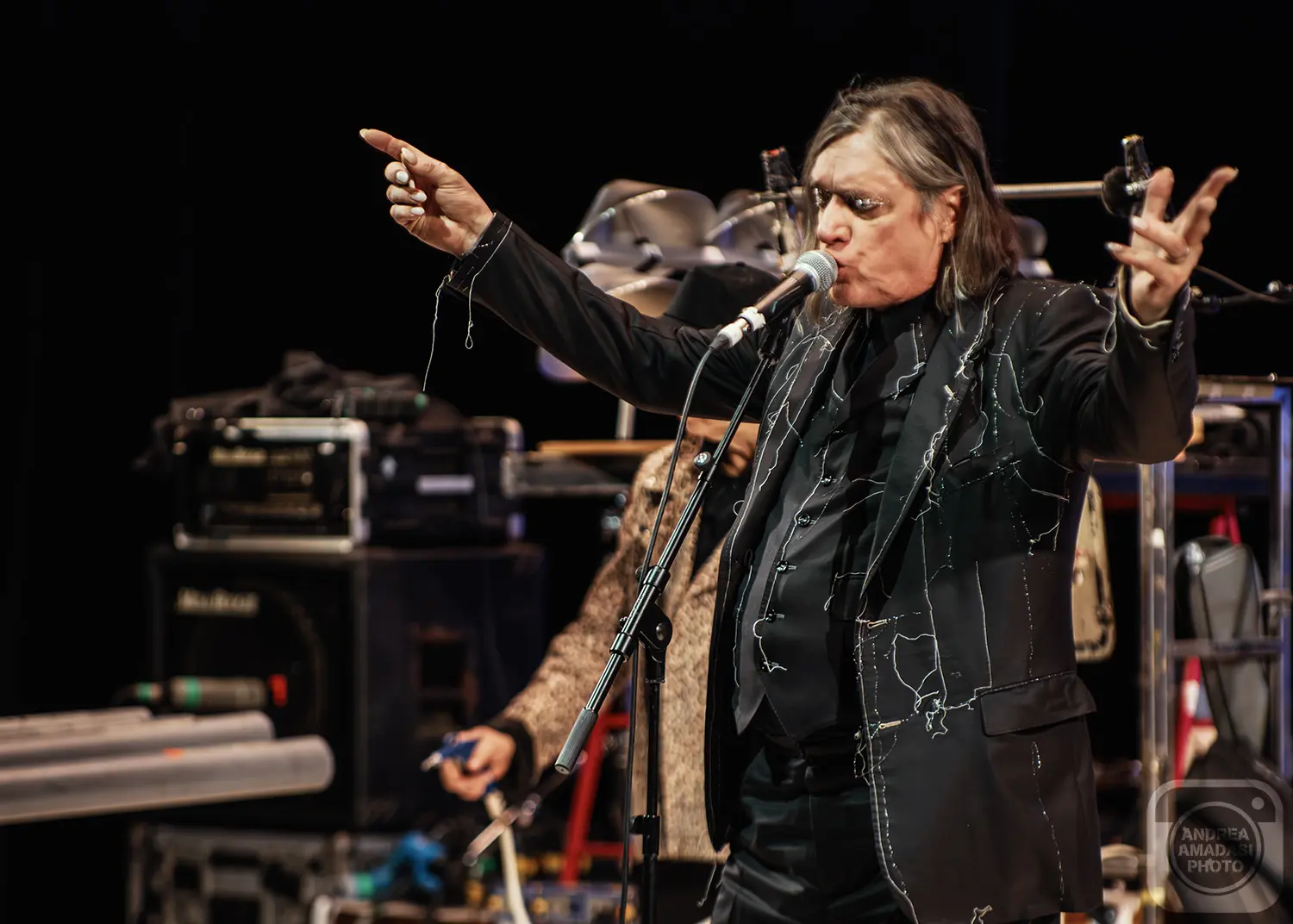
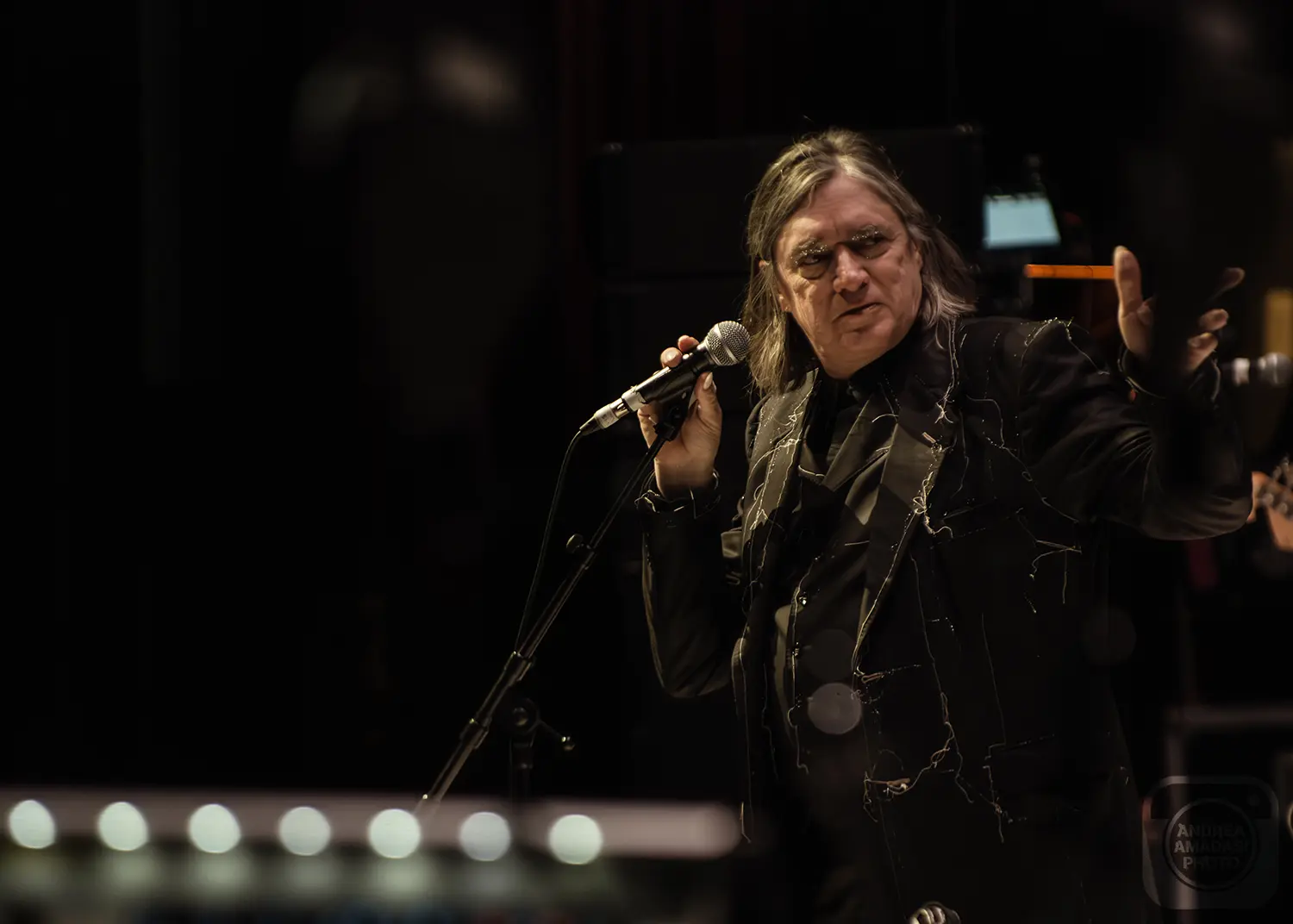
With “Die Befindlichkeit des Landes”, from 2000’s Silence Is Sexy, the concert becomes overtly theatrical. Bargeld changes his posture and articulation, stretches his vowels and works the pauses with an actor’s sense of timing. During “Sonnenbarke”, he commands the room as a master of ceremonies: he gives no announcements or explanations and holds everyone still. Bargeld’s posture recalls Weimar cabaret as Bob Fosse captured it in the 1972 film Cabaret: Joel Grey, as Master of Ceremonies, controls the Kit Kat Klub while Nazism advances outside. At the Valli, spectacle and threat occupy two levels of the same theatre. Bargeld holds the audience from the stage; above him and above the stalls, one of the four allegories on the vault painted by Domenico Pellizzi in 1856 depicts Tragedy itself.
Then the stage turns red and remains red throughout “Sabrina”. On 1 June 1980, Bargeld and Unruh recorded Stahlmusik inside the support pillar of a flyover on the Stadtautobahn, and the cassette was released that October by Eisengrau, the shop where the band rehearsed. In 2026, the same vocabulary is spoken through instruments built and tested for the tour. Away from the city that gave birth to it, in a 1,100-seat theatre lined with gilded boxes, that sound still holds together perfectly.
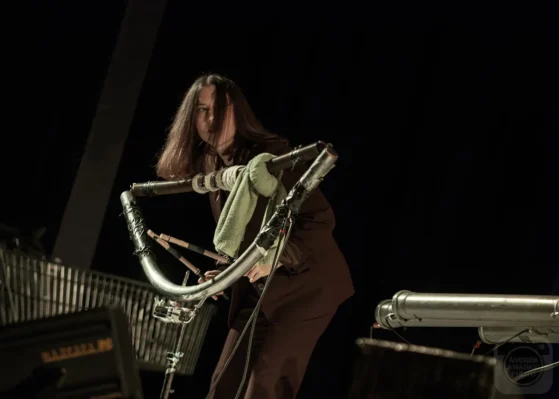
“Seven Screws” takes the set back to Alles in Allem. On “Trilobiten”, also sung in English, the pipes enter the arrangement. On the album, Unruh plays PVC pipes. Here he works with an air compressor, Moser plays the bass drum and metal percussion, and Arbeit switches to amplified harmonica. This is the evening’s only proper spoken introduction. Bargeld has explained where the song began: at Expo 86 in Vancouver, after the concert, the organiser gave him a trilobite fossil and claimed that it came from an age before the distinction between male and female. From this came a lyric that calls its two protagonists fossils not yet differentiated and repeats “I” and “you” until both are worn away. Forty years after Vancouver, that fossil has become a song and made its way onto the stage in Reggio Emilia. Before “Gesundbrunnen”, Bargeld speaks again to name the album the piece comes from, then immediately returns to the performance.
The main set ends with “How Did I Die?”, from 2014’s Lament, and the theatre vibrates. The project began with a commission from the Flemish town of Diksmuide to mark the centenary of the outbreak of the First World War. Einstürzende Neubauten composed a stage work intended for live performance and presented it there on 8 November 2014. The album, released the previous day, contains studio recordings of the music written for that work. Bargeld describes it as documentation for precisely this reason. The album preserves the compositions. Onstage, N.U. Unruh’s enormous instruments and noise generators give those compositions a physical presence, making the horrors described by the music visible.
Among the instruments played in that production were the artillery shell casings assigned to Moser. At the Valli, the arrangement changes. On the album, a quartet plays the string part, including a cello solo; here, the quartet is absent. Die Rote Melodie is not performed that night. In the liner notes to Lament, Bargeld cites it as a precursor to How Did I Die? The earlier song is a chanson with words by Kurt Tucholsky and music by Friedrich Hollaender, dedicated to Erich Ludendorff, a general and one of the senior commanders of the German army during the First World War. In Tucholsky’s text, a dead soldier accuses the general. Bargeld takes up the same idea: in How Did I Die?, the dead speak in the first person, reconstruct their own deaths and eventually declare that they have returned “with another song”. The connection to the cabaret evoked earlier by Bargeld’s posture lies here, in the political chanson of Weimar Berlin and its ability to give even the dead back their voice.
They introduce the line-up, say goodbye and leave the stage. The first encore opens with “Nagorny Karabach”, from 2007’s Alles wieder offen, and continues with a Rampe, the name Neubauten give each improvisation built in performance. Since the 2022 tour, these performances have begun with a few agreed coordinates: who starts, with which instrument and, in some cases, a sequence of notes encoded in the title. Bargeld uses fragments of text as triggers for the voice. During that tour, the group recorded twenty-three of them (Rampen is the German plural of Rampe) and later selected fourteen, reworking them in 2023 at the Candy Bomber studio in Berlin for the album Rampen (apm: alien pop music). At the Valli, the process takes shape before the audience: sonic fragments accumulate, and the structure remains open to the end. The encore closes with “Susej”, also from Alles wieder offen.
They return for a single song, “Stella Maris” from 1996’s Ende Neu. Josefine Lukschy puts down the bass and steps up to the microphone. Lukschy takes over the part originally sung by Meret Becker; their voice intertwines with Bargeld’s. Alexander Hacke announced his departure from the group in April 2025, stating that their fundamental standards now differed at every level, both personally and professionally. Lukschy, formerly of Crashpad, joined the line-up in 2026 after two rounds of auditions. This is the night when a line-up change stops being news and becomes a vocal line. At 10.50 p.m., the concert ends after one hour and forty-one minutes.
One choice is worth noting because it says a great deal about the group. Of the seventeen songs, the oldest dates from 1996. The Berlin of the 1980s, projected upstairs at 6 p.m., is absent from the setlist downstairs at 9 p.m.: there is nothing from Kollaps, Halber Mensch or Haus der Lüge, released in 1989, the year Lukschy was born. The programme excludes the first sixteen years of the band’s work. The three Berlin place names in the setlist, Wedding, Grazer Damm and Gesundbrunnen, also belong to the post-reunification repertoire.
The earliest part of that story had already appeared on the screen. The film had brought back the scene in which Neubauten were born; the concert addressed what came after. The distance between the two completed the picture.
The shopping trolley was exactly where one expected it to be. The Rampe, too, was expected, and the piece would take shape in performance. Forty-six years on, Einstürzende Neubauten take the stage surrounded by objects that now belong to their history, proving that no new building can ever truly collapse while its builders keep striking it.